For managers, HR, engineers and anyone curious. Every idea is something you can touch: train a neuron, open a model file, plan a GPU, and find the task worth fixing in your own factory.
CowgyHi, I'm Cowgy, Sunny's sidekick. Use ← → or swipe. I'll leave you one line to remember in every chapter.
Learn · chapter 1
How AI got here.
a 70-year climb to today's models
AI didn't begin with ChatGPT. It's a long climb from a single artificial neuron to models that read, see and talk — with computer vision (yes, YOLO) as a major waypoint. The short version:
1958
Perceptron
The first artificial neuron that learns from examples.
1986
Backprop
Training networks with many layers becomes practical.
1998
LeNet (CNN)
Convolutional nets read images — starting with handwritten digits.
2012
AlexNet
Deep learning wins ImageNet; the modern boom begins.
2015
YOLO
Real-time object detection: "you only look once."
2017
Transformers
The "attention" idea that underpins today's LLMs.
2020
GPT-3
Sheer scale gives language models startling ability.
2022
ChatGPT
AI lands in everyone's hands at once.
2023 →
Multimodal
Models that see, hear, and act — not just chat.

CowgyAI is 70 years old. What's new is that it finally works well enough for everyone.
Learn · chapter 2 · what AI actually is
AI, from a different point of view.
We have always learned by copying what we see. When we wanted to fly, we studied birds — yet we never built feathers or flapping wings. We took the principle, lift, and gave it a different mechanism: a fixed wing and an engine. The plane is not a bird. It flies anyway.
A large language model is that same kind of copy. It is not a replica of human consciousness, and it does not think the way a brain does — that picture is tempting, but not quite true. Yet it remembers much as we do: we grow sure of something by meeting it again and again — in books, and in what we see and feel — until it settles in. Training does the same to the model; each pass presses a pattern deeper into its weights, until recall comes quickly, and with confidence.
CowgyA plane isn't a bird, but it flies. AI isn't a brain, but it works.
Learn · chapter 3 · before the maths
Simple rules, repeated.
简单的规则,重复很多次,图案就出现了。Peraturan mudah, diulang berkali-kali — corak pun muncul.
This fern is four simple rules, repeated tens of thousands of times. Zoom into any frond and there's the whole fern again. Most folks never look at a fern up close. I have: I used to pluck them.
Now the dice. Three corners. Roll, jump halfway toward that corner, leave a dot. That's the whole rule, yet a triangle of triangles always appears, wherever you start.
Find the pattern, recreate the whole. That's exactly what a neural network learns to do. Next chapter: the simplest one.
press play
0 dots
CowgySimple rules, repeated, make complex things. That's the trick behind AI too.
Learn · chapter 4
The simplest form of AI.
This is a perceptron — the simplest neuron. It takes two inputs (here a part's width and roughness), weighs them, and asks one yes/no question: which side of the line does this point fall on?
The line is set by three numbers — the weights w₁, w₂ and the bias b. Change them, and the line moves.
Training isn't random. It sweeps the points over and over — one pass is an epoch — and nudges the weights to fix each one it gets wrong. Soon the line splits the two groups. That's all "learning" is.
Drag the weights, or press Train and watch gradient descent find the line in real time.
live neuronb = +0.0
+1.0
+1.0
+0.0
errors— / —
CowgyLearning is just nudging numbers until the mistakes go away.
Learn · chapter 5
How a network sees.
A single neuron sees one number at a time. A convolutional neural network sees the way an eye does — in little patches. It slides a tiny grid of weights, a filter, across the image; at each spot it multiplies and adds, and the result says how strongly that patch matches what the filter is tuned for. One filter fires on vertical edges, another on corners.
Stack these layers and the features compound: edges become shapes, shapes become parts, parts become whole objects — all learned, never hand-written. That is exactly what AlexNet did, next chapter. Pick a filter and watch the feature map it produces.
input
→
filter
→
feature map
The filter slides over every patch — each result is one pixel of the feature map.
CowgyA network sees in small patches: edges, then shapes, then things.
Learn · chapter 6 · Vision
Machines learned to see first.
The modern wave of AI did not begin with chat — it began with images. For decades, getting a computer to tell a cat from a dog meant writing the rules by hand, and it barely worked. Then in 2012 a model called AlexNet stopped using hand-written rules and learned the features straight from the pixels. It read photographs better than anything before it, and the field changed almost overnight.
Next came speed and place. YOLO — "you only look once" — didn't just say what was in a picture, it said what and where, fast enough to run on live video. Seeing had become something a machine could do in real time.
Only after vision had proved the idea did the same principle — learn from raw data, not from rules — reach language. The transformer arrived in 2017 and carried it into text, and later back into images, sound and more. So the order matters: first we taught machines to see, and almost everything else followed. The next two chapters open up that first step — what an image actually is, and how a computer reads colour.
2012AlexNetrecognised objects straight from raw pixels
↓
2015YOLOwhat and where, fast enough for live video
↓
2017Transformerthe same idea, carried into language
CowgyMachines learned to see first. Language came later, with the same idea.
Learn · chapter 7 · OpenCV
An image is just numbers.
A photo is a grid of pixels — each just a number from 0 (black) to 255 (white). Colour stacks three grids: red, green, blue. So every edit is arithmetic on those numbers. Drag the sliders:
hover the image to read a pixel →
the same image, as a numpy array · hover a cell
0
0
128
Blur replaces each pixel with the average of those around it, softening noise and fine detail. It's usually the first step before Threshold or Edges — smoothing first stops stray specks from turning into false lines. More blur, softer image, less detail.
CowgyTo a computer, a photo is a grid of numbers from 0 to 255.
Learn · chapter 8 · OpenCV
Colour, and finding it.
RGB mixes a colour from red, green and blue. HSV re-describes it as hue, saturation and value — which makes one colour easy to pick out of an image. Mix one, then isolate one:
mix · rgb → hsv
177
78
55
hsv—
isolate · hue range
0°
28°
CowgySwitch from RGB to HSV and picking out one colour gets easy.
Learn · chapter 9 · inside a model
A model is just one file.
AI 模型只是一个文件:一个小表头,加上几十亿个数字。Model AI hanyalah satu fail: kepala kecil, dan berbilion nombor.
Open it up: no spells, no black box. A small header that describes things, then billions of numbers. Click any part of the file to look inside.
qwen3-8b-Q4_K_M.ggufGGUF
archqwen3
params8.19 B
blocks36
width4096
heads32
context40960
vocab151936
size5.0 GB
blk.0.ffn_gate.weight12288 × 4096
Same story with GGUF, safetensors or ONNX: the format only changes how it's packed. Inside, every model is the same thing: numbers learned from data. 8.19 billion of them in 5.0 GB works out to about 4.9 bits each. Chapter after next explains why.
CowgyA model is one file full of numbers. No magic inside.
Learn · chapter 10 · under the hood
One word at a time.
它不是在思考,而是一个词一个词地猜。Ia tidak berfikir — ia meneka satu perkataan demi satu perkataan.
It doesn't "know" anything. Your words are cut into tokens and turned into numbers. The numbers flow through the layers, and out comes a score for every possible next word. It picks one, adds it, and does it all again.
Temperature is how adventurous the pick is. Low: always the top word. High: sometimes a surprise.
how fast it writes
1.00
Scores and token numbers here are an illustration, not a real model's output.
CowgyIt doesn't think. It guesses the next word, again and again, very well.
Learn · chapter 11 · your PC is a kitchen
Will it fit on your GPU?
显卡是灶台,内存是冰箱,硬盘是仓库。GPU ialah dapur, RAM ialah peti sejuk, SSD ialah gudang.
Pick a model, then try 16 bits, then 4. The GPU is the stove: fastest, but small. RAM is the fridge: bigger, a walk away. The SSD is the warehouse: huge, and slow to fetch from.
A 27B model at 16 bits needs about 54 GB. No home GPU holds that. Squeeze each number to 4 bits and it's about 16 GB: it fits on a 24 GB card. That's quantization: a little less precise, much smaller.
Like a photo with fewer shades. 4-bit still looks right; 2-bit starts to break.
model
bits
GPU
RAM
this model needs—
StoveGPU memory
FridgeRAM
WarehouseSSD
Rough maths: size × bits ÷ 8, plus a little working space. Real numbers vary by model and settings.
CowgyFewer bits per number, smaller model. 4-bit is the sweet spot at home.
Learn · chapter 12 · talking to AI
A prompt has six slots.
一个好的提示有六个格子。答错了,通常是少了一格。Arahan yang baik ada enam ruang. Jika jawapan salah, biasanya satu ruang tertinggal.
Most people send one slot: the task. You don't need all six every time, but when the answer is wrong, the fix is almost always a missing slot, not a smarter model. Switch them on and watch the prompt grow.
example
1 / 6
what you send
CowgyWrong answer? You're probably missing a slot, not a smarter model.
Learn · chapter 13 · so what is an agent?
An agent is a loop, not a reply.
代理不是回答一次就停 —— 它会一直绕圈,直到把事情做完。Ejen bukan jawab sekali — ia berulang sampai kerja siap.
A chatbot answers once and waits. An agent keeps going: think → act → look → check, and again, until the job is done. Give it a real job and press Run.
📧 Draft ready. Send to the customer?
Least access权限最小 · Akses minimumRead-only first预设只读 · Baca sahajaYou approve sends寄出前要批准 · Anda luluskanCustomer data stays home客户资料留本地 · Data kekal di sini
CowgyA chatbot answers. An agent keeps going until the job is done, and asks you before it sends.
Learn · chapter 14 · your own GPU
Why AI runs on a GPU.
CPU 像几位大厨,GPU 像几千个帮手一起做。CPU seperti beberapa tukang masak handal; GPU seperti ribuan pembantu serentak.
AI is millions of small multiplications that don't wait for each other. A CPU has a few strong cores (a desktop has 8 to 24). A GPU has thousands of small ones: an RTX 5090 has 21,760. Each is slower, but they all work at once. Give both the same job:
job size
CPU8 strong cores fast each, few of them
—
GPU256 small cores shown slower each, all at once
—
An illustration with made-up timings. For real AI work the gap is often ten times or more. The GPU was built to paint millions of pixels in games; AI turned out to be the same kind of job.
CowgyAI is millions of small sums at once. That's exactly what a GPU is for.
Learn · chapter 15 · tidbits from my desk
What one GPU can do today.
一张显卡:图片、视频、音乐、声音,都在公司里完成。Satu GPU: gambar, video, muzik dan suara — semuanya di dalam syarikat.
Timed on my own RTX 5090, in my office, capped at 400 W. Nothing leaves the building.
~9 sTwo photo-real images from a sentenceKrea 2 Turbo
~6 sEdit a photo with words: "make the room brighter"Qwen-Image 2.1 edit
~30 sA 5-second video with sound and speechMiniMax H3
~22 sA 30-second song, with vocals if you wantMiniMax Music 3
2–4×Sharper, bigger photos and videoSeedVR2 upscaler
secsClean cut-outs, background removedBiRefNet
fastNatural voice-overs, on a laptopKokoro TTS
2–13 sA private chat model rewriting prompts, on a MacBookQwen 3.5 9B · llama.cpp
Made by AI · not a photo
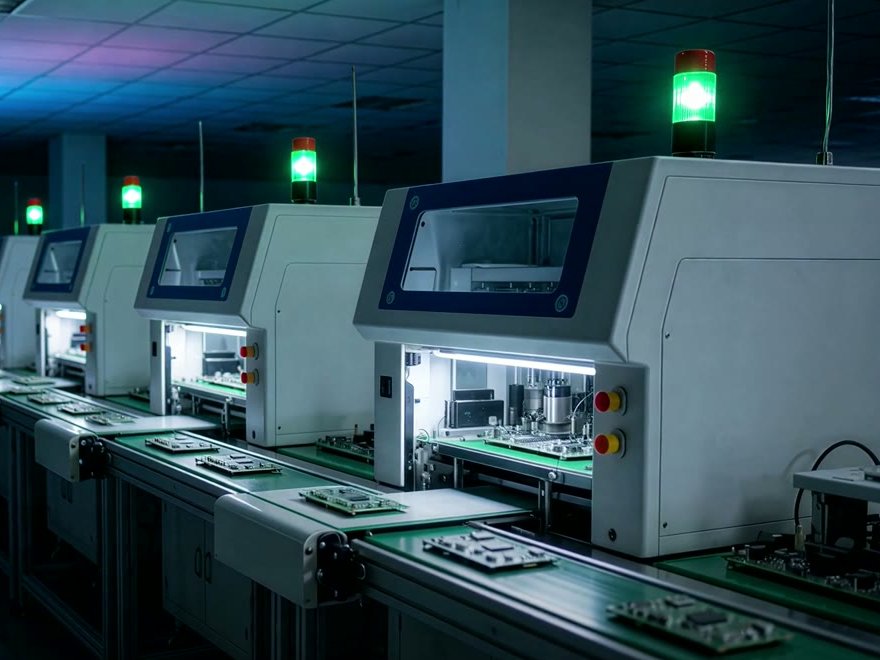
This factory never existed. Epic Studio, my own studio app, made this SMT line on that same GPU for a customer film. No camera, no site visit.
One catch: an AI photo edit redraws the whole picture, faces included. For photos of real people, I stick to a plain exposure fix.
Speeds change every month. That's the point: what needed a studio last year runs on one card in your office now.
CowgyOne GPU in your office can make pictures, video, music and voice.
Learn · chapter 16 · do the sum
Rent the frontier. Own the routine.
最尖端的用租的 · 每天在做的用自己的。Sewa yang terhebat — miliki yang harian.
—GPU pays for itself
—cloud seats, 3 years
—one GPU, once
20
120
14,000
which one?
confidential→ local
high volume→ local
must not stop→ local
one-off, best quality→ cloud
no hardware yet→ cloud
Rough numbers from my own class: an RTX 5090 at about RM 14,000 against 20 cloud seats at about RM 29,000 a year. Power, setup and support aren't included. The shape is what matters: one is a wall, the other is a staircase that never stops.
CowgyRent the frontier. Own the routine.
Learn · chapter 17 · from the factory floor
Find the task worth fixing.
先修那些重复、有规则、一出错就很贵的工作。Baiki dulu kerja yang berulang, ada peraturan, dan mahal bila silap.
After 20 years on production lines, I can tell you: the mistakes that hurt aren't random. They come from tasks done hundreds of times a day, by tired people, where one slip is expensive.
Ask three questions. How often?What does a mistake cost?Is there a clear rule? Pick a task, or move the sliders to try one of yours.
verdict
CowgyFix the task that's repeated, rule-based and expensive when wrong. Leave judgement to people.
Learn · chapter 18 · how I work
Build in hours, prove in days.
几个小时做出来,几天内证明有用。Bina dalam beberapa jam, buktikan dalam beberapa hari.
Big AI projects fail slowly. I do the opposite: watch the task, build a rough tool fast, and run it beside the person doing the job until the numbers say it works.
If it's wrong, you've lost an afternoon, not a quarter. If it's right, it runs on your own PC or server and your team owns it.
Pick one of my tools and step through how it was made:
CowgyBuild small, run it beside the person, then let it run. An afternoon lost beats a quarter lost.
Learn · chapter 19 · do the sum first
Count what changed.
动手之前先算一算。Kira dulu sebelum membina.
Before I build anything, we do the sum together. Put in one of your tasks. If the numbers don't work, don't build it. The hours that come back go to the same people, for better work: automate a chore, not a job.
—hours back a month
—mistakes caught a month
—RM saved a month
—pays for itself
22 working days a month. Your numbers, not mine: a rough guide, not a quote.
CowgyDo the sum before you build. If it doesn't pay back, don't build it.
recap · one screen
19 ideas to take home.
十九个重点,一页看完。Sembilan belas idea, satu skrin.
CowgyTap any card to jump back. Screenshot this page: it's the whole lesson on one screen.
that was the free sample: 19 chapters
Got a task that keeps going wrong?
I'm Sunny, and Sunny Bytes Solution is my company. 20+ years in electronics manufacturing and test taught me where the mistakes come from. Now I build the AI tools that stop them, and I teach teams to use AI the way this lesson does: hands-on, in English, Mandarin or Malay.